Share


Richard's blog

The Stages a Relationship goes throughRelationship counselling provides a structure for you to nourish and build on what works in your relationship and have a safe place to work through issues.

Like many couples you might find yourselves getting stuck repeating the same arguments and patterns or it may be you want to have more intimacy or you wish to work through a break of trust.

It's common these days to get tired, stressed, worn down through work commitments or looking after children which leaves little time to focus on your relationship and each other.  Sometimes busy-ness fills the gap to avoid looking at what is going on.

If you are in conflict it can be reassuring  to know that periods of 
conflict are normal and can be worked through. It's how you deal with the conflict that counts. 

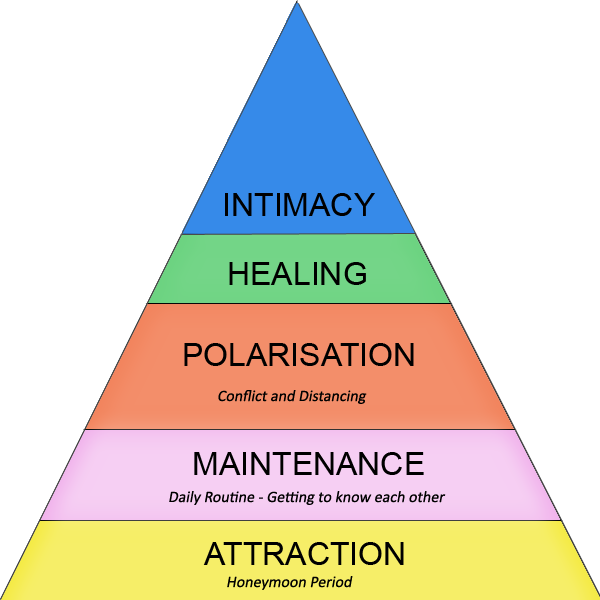
The Pyramid Diagram provides a structure to show how relationships change over time. Understanding the  different stages helps you understand your relationship better. It can also be reassuring to see that what you are experiencing fits within a stage.

I'll describe each of the five stages:

  1. Attraction - Little effort is required to feeling loving and loved
  2. Maintenance - Getting to know each other through day to day living
  3. Polarisation - Conflicts and arguments arise that create distance
  4. Healing - Conflicts are worked through
  5. Intimacy - Trust and good communication bring security and closeness

Attraction - Feeling Loving and Loved

In the Attraction Stage we usually see the best of each other. We are attracted to our partner’s qualities that compliment us or that we would like more of in ourselves. Attraction as well as being physical, is based on common values, similar status, shared ambitions and interests. It also has an unconscious element. Our unconscious attracts us to someone who is “familiar”  in some way. We are attracted to someone who fits our unconscious relationship bonding pattern.

Some couples come for relationship counselling early on in their
relationship when they have been hurt before and just
need some support, or reassurance, or would like to work through some
differences to allow trust to build. Understanding the messages you received early in your life about relationship and trust can help you to understand your feelings rather than be controlled by them.

Maintenance - Day to Day Living

We get to know each other through the routines of life. A loving emotional bond builds through getting to know the real person and through being known ourselves.The feelings of desire and passion tend to fade unless a couple actively keep their relationship fresh and alive. It's normal to some face some disappointment when our partner doesn't live up to the image we had of them. In this stage we might not yet feel safe enough to be fully ourselves and say what we feel, so we find ways of avoiding major conflict or feeling vulnerable. Anger or withdrawl can be away of protecting the relationship from underlying feelings.

We may avoid the big issues out of the fear of losing the love we want. We are comfortably close, yet avoid becoming closer, even though part of us would like to be. It's common for couples to be in a distance/persuer pattern. One distances while the other pursues. For some of us our relationship looks fine on the outside, yet on the inside we don't feel relaxed and free to be ourselves. Suppressing what we feel   leads to a lack of energy and sexual desire. Maybe there is, that ,'something missing feeling?' or  "I don't feel I am being myself ?" feeling. It could be are the "good partner" at the cost of our needs because we learnt that you need to be 'good' to loved.  Maybe we would like more passion and grit, but we are not sure how to bring it into the relationship. So often the answer seems to be that," it's our partner that needs to change"; or the answer seems to be outside the relationship.

Relationship counselling can help you  communicate better and feel safe about exploring  what's important to you. We focus on how you as couple create a shared pattern.   It's a relief to be both looking at a shared pattern rather than looking for who is to blame.

Relationship counselling isn't just about looking at problems.  It's also about building skills on how to appreciate each other and find ways to anourish your relationship.

Polarisation - Conflicts and Arguments Create Distance

A degree of conflict is part of a healthy relationship. It's how we communicate and work through our differences that counts.  The Polarisation stage is about  speaking up for what is important  while also being able to stay in relationship and be open to the  opposite points of view from our partner. This can  feel impossibile when we feel raw and  triggered into strong emotion by each other. Arguments become unmanageable; issues can't be talked over, and resentment builds. We may be caught up in hurt feelings and begin to distrust each other. There might be a sense of failure and a longing for things to go back as they were at the beginning of the relationship. It's common to wonder ,'how come other couples we know seem to mange and we are going through this?  Polarisation is triggered by events such as:-

  • Making a commitment
  • Moving in together
  • Soon after getting married
  • Just before or soon after having children
  • A break of trust

Typically polarisation starts a few years into a marriage or committed relationship where it feels safe to move beyond the maintenance stage. Sometimes a partner attempts to deal with a feeling of disconnection through using pornography, drinking, or having an affair or doing something else that leads to a break of trust.

Our parents/caregivers gave us a model template on how to be in relationship. It's where we learnt how to be loved and how to protect ourselves from being hurt. These unconscious bonding patterns remain active and are triggered in response to our partner.

Often we protect ourselves by unconsciously trying to control our partner by becoming parental. In response they defend the activated vulnerable child feelings  by starting an arguement  It might come as a surprise to discover that you and your partner unconsciously co-create the issues. It takes two. It’s bizarre, yet it's just how our unconscious works! Have you noticed how you can be more upset with your partner than with anyone else? Some couples are fortunate in that they can  "live with" their bonding patterns in relative harmony without needing to look at them. For many of us, spending some time understanding our bonding patterns can free us up from reacting in the same ways and having the same arguements over and over.

Relationship counselling offers a place to explore .We look at how you trigger each other and how to make sense of it,so you can step back, see what is going on, and respond rather than react. You discover that issues can be spoken about and worked through without repeated arguments.

Healing - Conflicts are Worked Through

Healing is a process that happens over time as we learn to include both our strength and vulnerability. We appreciate the limits of what our partner can give us , and how to love and nourish ourselves at the times our partner can’t. We take responsibility for the relationship patterns that are no longer serving us. We learn to risk trusting again. Relationship counselling gives you the opportunity/ skills/ framework to stop blaming each other and work together on the shared bonding pattern. You can, end "the relationship (pattern) as it is” and learn together step-by-step, how to love again from a place of authentic intimacy, and choice.

Intimacy - Building A Strong Emotional Bond

We all want to love and be loved. In order for 'a meeting of hearts' to take place, barriers must be dropped. Intimacy is a challenge as it requires us to step into the unknown, risk rejection and open our hearts. So often, in moments of intimacy we connect to our past longing and dependency. Relationship counselling helps you to take steps towards emotionally connecting to each other and re-build your emotional bond step by step.

Conclusion

Relationships are a great challenge for most people. Some couples never dare to discuss how they really feel inside (they stay in the Maintenance Stage); Others put up with conflict and hostility (they stay in Polarisation Stage) or believe the solution is to leave their relationship  (the denial of one's own pattern to avoid working through the Polarisation stage.)

Paradoxically, it's just at the point when everything feels stuck and hopeless, and in crisis, that there is the motivation to face up to what is not working. A Relationship counselling session once every other week is  powerful transformational process if you are stuck in conflicts and arguments that leave you emotionally disconnected from your partner. My experience is that most couples find getting help a relief, and those who are willing to take an honest look at what is going on,worthwhile. 

Copyright. 2012 Richard Cole

Relationship Counselling for Boarding School Survivors

Submitted by Richard on Tue, 02/21/2012 - 16:36

man woman bubble

Boarding School Still Affects You Now

It might seem strange to be speaking of boarding school on a relationship counselling site. It’s worth considering that even though you  may have attended a boarding school long ago the experience might still be having a huge impact on how you relate to your partner now.

The purpose of this article is to mirror back and encourage you to reflect on your experience of boarding school or be curious of the impact as a partner or as a child of a boarder. Consider how the experience back then links to your experiences now. Being conscious of the impact boarding school had on you brings you one step closer to re-integrating the parts of yourself that have been suppressed.

What's The Problem?

There are difficulties speaking about boarding school experiences in anything but a positive light. After all it is associated with privilege. Your parents may have made sacrifices to afford the fees and you may feel fortunate to have attended. It may have lead to good opportunities in your  life. You might have had a good time and got a lot out of it. Nonetheless, there’s evidence to suggest that it does have an impact on how you learn to manage feelings and how to relate intimately to others.

If you have been to boarding school there is a tendency to deny it’s affected your feelings in anyway at all. A typical response is, “Maybe for others, but I was fine with it”. The effect on feeling is subtle and profound. I encourage you to take time to reflect on your experience if you, or your partner or any of your parents went to boarding school.

Quantity Time With Parents Counts

To a greater or lesser extent we are all challenged in intimate relationships depending on what we experienced and learnt about being close to others from our parents in early life. We also learn as adults.

Attending  boarding school at a young age living away from our parents interrupts the natural process of learning about who we are from the repeated interactions with our parents.  This is particularly true in developing our capacity to be with and express our feelings. If you had parents who were not able to attend to your needs some of the points below may equally apply even if you didn’t attend boarding school.

Boarding School Survivor Symptoms

Incredible Independence

Our culture over-values independence. If we are emotionally independent we are not able to deeply connect to others. Well-being requires a balance between independence and dependence. This is sometimes called inter-dependence.

 For many, the experience of boarding school requires independence at too young an age at the cost of normal and healthy feelings of dependence.  Boarding school  curtails the seeking of healthy dependence in the form of maintaining an emotional bond and love with a parent. The break in the emotional bond with a parent can result in an unconscious defence against seeking deep emotional bonds and allowing love in later in life.

If those early feelings of dependence are attended to in childhood a natural authentic inter-dependence follows . We learn how to meet our needs. We learn to attend to ourselves and we learn to give and receive affection. The result is a secure feeling of attachment.
It’s common for boys to be  encouraged to toughen up to be become “unfeeling men”   as a misguided requisite to survive in a competitive world. Boys are given this message anyway. Boarding school compounds it.

Being separated from your parents at a young age to go off to boarding school encourages you to suppress what you are feeling. How would you otherwise manage being placed in a structured rules based environment where there is no one to witness how you feel or what you need?

If you went to boarding school you may a some point discover a fear of getting closer to your partner. The fear is that closeness would activate the old feelings of dependence that were not safe to have back then so you unconsciously repressed them.

In a relationship each partner unconsciously affects the emotions of the other to maintain a balance. What one resists feeling, the other feels. It’s common that the partner of a boarding school survivor can end up feeling stupid, incompetent or overly-dependent which are the disowned feelings of a boarding school survivor who is only allowed to express competence, success and fatherly rationality.

Disconnection From Self

Being connected to yourself means that you are able to interpret the felt sensations in your body as feelings. Feelings help you respond to others and evaluate what is going on around you. They help you determine what you need moment to moment.
  Disconnection from your self occurs when you numb or constrict your bodily sensations. This lack of connection from your body prevents you experiencing  an instinctual sense of what need. Disconnection is a learnt primitive defense to a perceived threat. When we are disconnected from our body we tend to rely on thinking to feel safe.

Boarding school subtly encourages over use of the intellect and suppression of feeling. It can be hard to see this as our society encourages conformity over being true to oneself. In boarding school you need to fit in, follow the rules and conditioned to accept the norms of suppressing “unwanted” parts of yourself to become successful. Some may believe that boarding school is a good training for life. It’s a powerful illusion. It’s not that the messages in themselves aren’t bad, ‘There is nothing wrong with wanting to be successful’. The subtly is in seeing what we are unconsciously encouraged to suppress in ourselves along the way. The price of conformity in boarding school is to disconnect from what we feel.

Disconnection From The Feelings Of Others

A learnt way to manage feelings that are not mirrored back as being OK is to repress them through disconnecting from your body. The effect is you are not sure what you are feeling. The experience of feeling may become intellectualised so you, ‘think your feelings’ rather than feeling them.

If you are a boarding school survivor who has unconsciously learnt to suppress feeling, you may often be perplexed over what to do when your partner gets angry and why they are angry.

It could be that they feel you are disconnected from them. You might be listening and responding to the content of what they say from rationality and yet are not listening to the their feelings or responding with feeling. You may be unaware that you have habitually disassociated from your body and feelings.

Relationship Counselling For Boarding School Survivors

It's A Challenge

Boarding school survivors are often reluctant to come to relationship counselling as it challenges their sense of success. It is difficult to admit that there is a relationship problem that needs looking at. Forays into relationship counselling can be short-lived and the process minimised or ridiculed to distract away from the issues.

Can Be Effective If There is Commitment

Relationship patterns are co-created so it is most effective if both partners attend together. With the right commitment it’s possible to reconnect to disowned feelings and to find ways to authentically connect to each other. It’s rewarding to eventually discover a longed for place of safe rest in oneself and a deeper connection in your relationship.

Men..When You Mess-Up - Admitting It Is An Option

Submitted by Richard on Fri, 07/29/2011 - 01:45

man woman bubbleMen, it’s inevitable that at times you are going to mess up and get things wrong for your partner. Here are some pointers that I hope you find helpful from my couples counselling experience. There's a lot of good material here.

<First Forgive Yourself Otherwise You Will Be Defensive

When you have messed up and your partner is upset the first step is to forgive yourself. Avoid if you can, going into shame and self-hatred. This is what lies beneath the surface for most men who react with anger and defensiveness. Accept that you are as fallible as the next man. You are not alone in messing up.There's a dignity to be found in accepting yourself regardless of what you have done and be accountable for clearing your mistake as best you can.

You can be present to your partner, comfort her, regret what you have done and make amends. You can do this while connected to your male power . You need to face up to your partner's hurt and anger. It will be uncomfortable. You will feel better by doing what is needed to be done.

Stay Connected to Yourself.

Your partner wants to connect to you on a feeling level. In order to be open to this you need to stay connected to your body, so feel your feet on the ground , breathe from the centre of you body. Feel your body supported by the ground. If you lose connection to yourself , slow things down, slow her down,tell her you need a minute if necessary.

Notice any uncomfortable feelings that come up as she is talking to you. See if you can soothe yourself, notice the feelings without reacting from them. If you notice yourself loosing connection with your body do something to reconnect.

<Avoid Attempting To Shut Down Your Partner's Feelings

Men who are uncomfortable with their feelings often worry about their partner's getting too upset, not realising that it is their own feelings they are attempting to protect. It is better to become aware of what you feel and not worry about your partner expressing her feelings. Your partner is well versed in being emotional, you don't need to worry about her being upset.

Listening Tips

There is no mental technique to make your partner's upset go away. What is required is just to do your best to be there and be sincere. If at anytime  you feel overwhelmed, or angry tell her you need a 'time-out' for 10 minutes. It's essential  you make it clear that you really want to hear her out.and that you will be back in 10 minutes. If you are feeling scared or uncomfortable, soothe yourself by remembering she's not your mother and she can't, 'make you or break you- only your self-judgment can.

Listen to her emotional flow. Women have a different communication style to men so don't expect her to speak like a man. Men tend get be literal and argue about details, whereas women tend to express what they are feeling in the moment without focusing on the details or literal meaning.

Sift for the gold. Translate inwardly to yourself any digs or criticism into what she is saying she is needing now. E.g. Translate ' You never listen', into 'I really want to be listened to right now'. It helps you both stay connected if you  keep some kind of physical contact. Be attentive. Every time you break contact it feels like abandonment to her. Listen to the hurt she wants to express.

The content isn't necessarily the message. Tune into what she is saying on a feeling level. Could it be that she feeling abandoned because you have been emotionally pulling away? Remember to keep your breathing flowing so you keep feeling, in response to what she is feeling. Holding your breath suppresses feeling and generates anxiety.

Don't let any arrows of 'you never do this..or do that !' stick in. - It might be her hurt speaking that is too tender to be directly expressed. If she is being unkind just let her know by saying, 'Ouch!' which might be all you need to say. There are limits, and sometimes you need to tell her what the limit is. You can remain in your power and not accept  attempts to punish you. Focus on what she is feeling and needing now. If it's not clear, ask her.

There's room for two realities - 'yours' and 'hers'. First focus on 'hers' . You can show you are hearing what she is saying by reflecting it back to her without disagreeing or adding your interpretation. It's a timing thing; First you need to listen and tune into what she is feeling. At this point there is no need to defend, no need to be right, no need to correct the details of her truth. Let her get her emotional flow out first. The time to disagree is later.

Show her you are listening and slow her down by stopping her flow every now and then and saying something like..'Let me see if I'm getting this...[repeat back the key themes]'
If she is overcome with emotion give her time to express it...make physical contact..slow things down.

She just wants you to hear her hurt. She wants you to feel with her rather than rationalise. If you have messed up she wants to admit that you, 'messed up',without justification, without defending, without collapsing.

A classic male response is to quickly jump in with "I'm sorry" followed by a long explanation about how bad the man feels. Women want men to hear their feelings not tell her about how bad they feel. Keep the focus on her. She needs you to be  sincere and to be saying in your own words,'I regret  that I've hurt you'. 'I've hurt you..I messed up'. 'I've let you down.'

Validate her Feelings If you listen to what she is saying and step into her reality and imagine how you would be feeling if you believed what she believes then it's easier to connect. What men tend to do is to disagree straight off and argue the details in a logical way. Your partner wants you to get how she 'feels'. The way not to do this is to say ,"I understand", quickly followed by your point of view. Instead of saying ,"I understand", tell her in detail what you understand.

E.g. In response to your partner worried about a text message from a female work colleague, here is how you could respond to your partner's feelings:

"You saw that message on my phone from Sue at work inviting me to a drinks do, and you are worrying if it's just a drinks do or something more , I can really see that not knowing any more, you begin to wonder if there is something going on between us..and you are worried, and feeling angry. You feel distanced from me and right now wondering if I'm telling you the truth. I would probably be feeling the same if I didn't know more about my work colleagues".

If you sincerely focus on the feelings  and can see that her feelings make sense ( given how she sees the situation) and you can communicate that. In effect you are showing that her feelings are important to you.

If your partner keeps bringing up the same hurt, it could be because you are not being heart-felt in acknowledging the'feeling message' in what she is saying or that you have not made an adjustment in your behaviour towards her.

Summary

  1. First, forgive yourself for messing up.
  2. Listen to your partner's emotional flow while staying in your male power
  3. Check out with her that you have got the' feeling message'.
  4. Take responsibility for what she is right about first. 'you are right, I've messed up, I let you down'. Express regret. Don't argue the details. Focus on the clear up.
  5. Set limits if necessary. Don't accept punishment.
  6. Discuss disagreements if you need to.
  7. Reassure her.
  8. Walk your Talk: Make adjustments to your behaviour to remedy the situation.

Relationship Counselling

Most men find staying present when they have 'messed up' somewhere between: hard to impossible. It's not easy! You and your partner trigger bonding patterns in each other that  pushes each other's buttons like no-one else can.

If you are stuck in repetitive arguments attend relationship counselling with your partner. It can help you both find ways to understand each other better and work through repetitive patterns. You will find that problems are co-created and you can both work together to improve your communication.

Couples Counselling using Emotionally Focused Therapy

Submitted by Richard on Thu, 07/28/2011 - 22:59

when we were first together you made me feel so special

In this article:

  • Discover how to relationship counselling can help you speak differently to each other. 
  • Recognise the common themes that occur in arguments and see how emotionally focused therapy helps couples to speak  authentically and work through difficulties.

Made up yet typical extract at the beginning of relationship counselling:

Man: "You say I just want sex, but that is not true. I just feel like giving up when you say that , like we are doomed. How can it ever work?"

Woman: " I don't really know. But if you would just calm down and be less demanding. I just move away to stop the fights. I think it is better if we don't get caught in these arguments....it's easier that way"

Man: "How can things be 'easy' when we never make love, when you are never close to me ? Tell me that. It's like everything else comes first with you, but my feelings..they never count. You just focus on the event, like all I want is an orgasm. But that is not all I want. I want to feel close to you - desired- like I am important you. But first comes the kids, then the house, then your job, and then maybe if there is time left - maybe us."

Woman:"I just get that whatever I do I will never be good enough for you, I am a big disappointment..so I just give up. I  shut down. It doesn't feel safe anymore. I am not sexy enough for you, not warm enough - just not enough"

Same Couple a number of sessions later - illustrating how the speaking honestly about feelings and needs helps.

Woman: " I am starting to feel safer here. Like I am not on trial all the time. I just give up when I feel that, I just shut down and go numb. I am starting to get that we both get scared and insecure and then we don't know how to reassure each other." I want this relationship and you are important to me - very important. I feel lonely too, you know. I just want to feel held sometimes, and talked to, paid attention to- not always asked to make love. Then I just feel I am a route to orgasm, not that you want me." "when we were first together you made me feel like I was so special - so precious. I miss that-I do. But know you seem so mad at me all the time"

Man:"I know. I get desperate - I feel like I am losing you - so I guess I come on all furious and pushy. But really it's just because I am so unsure of us-of you. And it's pretty risky to tell you this - I guess it's easier to demand to make love."

I'm sure some of this extract will resonate with couples. It shows how couples misunderstand each other and blame each other. The man and the woman both have their own realities on what is going on, both are which are valid. They both long to have a feeling of love and secure emotional connection.

The first extract shows the themes of abandonment, rejection and the lack of safety that comes from feeling that your partner doesn't prioritise you. The 2nd extract shows the risks involved in reaching out. The fear of asking for what you need. The fear of expressing vulnerability and building an emotional bond by sharing how important your partner is to you.

Emotionally focused therapy in couples counselling helps the man and the woman identify the patterns of blame and where the misunderstandings are. They begin to appreciate their own and their partner's vulnerability and to be able to speak a deeper truth of what they are feeling and needing. Emotionally Focused Therapy in couples counselling shows couples that love comes from feeling that your partner is emotionally available to you, that want is important can be shared and received and that you are special and important to them. It teaches you how to communicate what's important.

Cheating - Why do Men and Women Cheat?

Submitted by Richard on Thu, 07/28/2011 - 14:36

cheating The reason men cheat isn't because they want sex. Men cheat because they miss the feeling of being admired and feeling a woman positively responding to them. Usually with their partner they feel criticised and undermined. Men need to feel they can make their partner happy and to feel admired and trusted. Men are motivated by knowing 'they can get things right' for their partner.

A lot of arguments are not really about the surface things, rather they are about a woman feeling the loss of an emotional connection and bond with their man. Not enough connection feels like abandonment. In an attempt to regain a connection women complain, and tell their men what they "are not doing right". Unfortunately men don't know that the complaining and criticism is actually a desire for connection. Men begin to believe that they, 'can't get it right for her' and lose self-esteem. Once the pattern starts of a man distancing and a woman complaining the man can become discouraged. When he tries to 'do the right thing', he soon gives up when the appreciation he longs for doesn't come instantly. He needs to perservere and appreciate his partner more in order to break the cycle.If he continues to distance it makes the lack of connection worse and his partner feeling more abandoned.

At these times some men are vulnerable to cheating on their partners to get a sense of self esteem and affection they long for. They attempt to re-experience what it is like to have a woman's positive attention. It's not really about sex at all. It's about the need to be admired.

Women cheat much less than men. They cheat as a last resort when they feel taken for granted by their partner. Women wish to feel appreciated, desired and special to their partner. Some women are more vulnerable to cheating if they have a friend who cheats as makes it seem more acceptable. The key factor for a woman deciding to cheat is that their partner has ignored their attempts to emotionally re-connect. Women cheat because their partner doesn't listen to them. It's hard for women to repeatedly bring up issues as they fear being seen as 'nagging'. Some men have learnt to avoid conflict so rather than listening and sorting things out they do something temporary or  wait for the issue to die down. What they don't realise is that a bit of the love and connection their partner feels for them also dies when issues are not taken seriously and addressed. Women reach a point where their feelings for the partner has been eroded sufficiently for them to be vulnerable to getting their needs met elsewhere.

On the unconscious level an affair is an attempt at problem solving. It's curious how cheating partner's unconsciously let their partners' know they are cheating as if they want the main issue to come out into the open.

Cheating interrupts the emotional bond between a couple. The break in trust hurts, shocks and shakes the betrayed partner. A break of trust can be worked through in relationship counselling resulting in a stronger partnership. It's a tough process and it takes time to work through the root issues to a develop a more realistic informed trust. Informed trust replaces blind trust

What can you do now to strengthen your relationship and reduce the possibility of cheating?

There are steps you can take:

Schedule in time in your calendars each week to have special time together/go on a date/do something that nourishes your relationship.

Take an interest in the emotional life of your partner, ask them what they would like more of/less of in the relationship. Take an interest in what is important them.

Learn how to express your feelings and needs in a way that your partner can give to you rather than feel they need to defend against being attacked.

.Get in touch with your needs by taking time to notice the felt sensations in your body. By tuning into ourselves we can discover what we need. We all have needs, yet society conditions us not to listen to our needs. Women are conditioned to think of others, not themselves, Men are conditioned to be in control and be strong. If we are not in touch of our needs and are unable to express them, we tend to unconsciously act them out

  1. Notice any tightness in your stomach and chest. Just keep your attention on the area and wait expectantly to see what feelings arise.
  2. Put what you are feeling/needing into words.
  3. Shape those words into a doable request. E.g. You notice some tightness under your rib cage..it's fear that your partner is meeting some friends tonight and you are wanting to feel emotionally closer to them. You realise you are some needing reassurance and closeness. You risk saying how you are feeling and make a request to your partner..I want to feel closer to you, I value spending time with you yet I feeling scared that you don't want to spend time with me. I'd really like it if we could do something together on Thursday ? and I could really do with a hug right now.

The surprising thing is that when we risk coming from our heart with what we want without attacking our partner, they feel connected to us and usually respond lovingly.

It's basic and powerful. Women, men want to be admired ( they want to know they can "get it right for you" and be appreciated for it). So if you are woman, ask your partner to help you with something that will make him feel good as a man and appreciate him
for it.

Men,women want to feel special. So tune in to what makes your partner feel special: Does she respond to loving words,
appreciations,gifts, you doing something for her, spending time together, surprise night out, physical touch? Women need to be told over and over that they are special. It's hard for men to understand how important it is for women.

Do You Have Trouble Expressing How You Feel?

Why not take steps to address it and get support. It's so much easier to work things through before drifting apart or resorting to "cheating" to bring what isn't being spoken about into the open

Copyright Richard Cole (2011)

Relationship Counselling - How To Communicate Better

Submitted by Richard on Fri, 06/03/2011 - 10:01

Mars and Venus lawn relationship communication

Talk About It

  • Being honest and real with each other is a scary thing, yet it's the way to go.
  • It's important to keep a "clean heart" towards each other so if something is bothering you, that makes you feel distant from your partner.Don't keep it to yourself - share it.
  • If you are fearful of having arguments or upsetting each other it's well worth getting some support to understand your fears. It's important that you can be true to yourself and express what you feel. If you learn how to listen and negotiate with each other, differences get worked through and don't lead to arguments.

Prioritise Having A Relationship Instead of Arguing About Who Is Right

  • Focus on what you want, rather than arguing over the details of who said what, when, and who is right. Often you both are !
  • It doesn't matter that you see the world differently along as you can agree a way forward that meets both your needs.
  • Be curious about what is important to your partner.  Respect the things that they say are important,  are important to them.
  • Remember when you are arguing that deep down your partner wants to connect with you.

There's Room For "Male Logic" and "Female Feeling"

  • Men tend to focus on the content of what is said and argue the details using, " male logic";whereas women tend to focus on the feelings underneath - "Female Feeling". In an argument it can be as if a man and woman are on two different radio channels, wishing the other to tune into their channel.
  • Here's a story that helps explain the differences:

    In ancient times  men would need to go out and hunt. They needed to  focus on one thing - the hunt and be direct with each other to work together to survive. Women would be busy child-rearing and keeping the social network together. Survival for the women was about keeping the social harmony . Directness was avoided as it was too confrontational and left them feeling vulnerable of being excluded from the group. They learnt the art of subtle communication where it was only necessary to hint at what was needed and the other women would pick things up without their being any confrontation. What was important was how each person felt and keeping the harmony and connection in the group. In modern times there is still the conditioning of men being validated for their logic and women being validated for their ability to tune in and connect with feeling.
  • Men and women both  benefit from honouring and appreciating the differences between the genders and realise that we have different life journeys and social conditioning. For many, it's a massive shift to stop expecting a partner to communicate in the same way they do. Men expect women to be logical and women expect men to pick up indirect signals.
  • Men can learn to listen to the feeling and respond with feeling on the "feeling channel" and women can learn to speak directly and with fewer words to men on the "logic channel".

In Arguments First Seek To Understand

  • In an argument both people want to be understood by each other. It's hard to remember this you are in the heat of an argument.
  • Tips for men:  It's hard to stand back a bit and first seek to understand what your partner is trying to say it terms of what they are feeling and needing. Learn to listen to the message underneath the content.
  • Show you are listening and understanding by respectfully interrupting your partner by saying,'Let me see if I'm getting this..' then; repeat back what you have heard ( without adding any judgments or justifications ). You don't need to agree with what your partner said or question it - first show you are hearing what is said. Check with your partner if they have more to add. Let them finish before responding. You don't need to repeat back everything, just the key bits. Yes,it can be difficult to do this!
  • Often the message sent isn't the message received. Your partner may feel you are criticising them when that isn't your intention. Sometimes it's worth asking them to say back to you what they heard you say. This does need to be sensitively done so your partner understands that your intention is to check that there isn't any miscommunication rather than your intention is to control or patronise them
  • Tips for men-  women rarely want you to offer solutions to what they are telling you about, unless they specifically ask. They are wanting you to hear them out.and offer reassurance that  you believe they will sort it out.

Schedule Quality Time Together

  • Schedule time together in your diaries so there is time to nourish your emotional bond and have fun together.
  • Make sure that you have uninterrupted time for love making. Allow plenty of time to connect and relax together before lovemaking so you are ready to make love in a connected way rather than use lovemaking as a way of discharging tension. Keep the focus on staying connected to each other, by slowing things down and sharing how you are feeling .
  • Quality time is about setting an intention to be fully open and available to each other and not to feel there is a pressure to  make love.
  • Appreciate your partner the moment that you  feel it. Develop the habit of noticing good feelings and expressing them.
  • The ratio of appreciation to bringing up issues should be 5 to 1. Appreciate your partner 5 times more often than bringing up issues.
  • The art to making an appreciation is to be specific - say what your  partner did ,what  you feel about it, and why it is important to you. eg." Last night when you listened to me telling you all about my work day...I felt so cared for and that you were really there for me. That's important to me because it makes me feel special and close to you."
  • Giving and receiving appreciations is a habit that takes practice and perseverance before it feels natural.
  • To receive an appreciation if you don't know what else to say just say ,'thank-you' and let it in.

Say What You Need

  • Good communication comes from a willingness to share who you are and that means risking being vulnerable and saying what you need.
  • Tips for Women -  Men easily feel overwhelmed with hearing lots of words and tend to want to focus on one thing at once. Say what you are wanting specifically. Remember that men want to feel appreciated and trusted to deliver so if you show you have faith in your partner and are trusting him to sort something out , and will appreciate him for doing so, he's going to be more responsive.

Here are the steps

1. Make your request as calmly as possible
2. Get agreement that he is willing to do it
3. Back off, so he is left with it. You are trusting him with it so you must maintain that trust for a period of time
4. If you need to follow it up, repeat the process and agree a specific time.
5. If you need to follow up again, say how in small and in big things him keeping his word is important for you in order to trust him.

See the Part you Play in any Issue

  • Relationship issues take two. A relationship is a system where the behaviour of one effects the feelings of the other and vice versa. If one of you is feeling insecure that could be because both of you are not talking enough for there to be a secure feeling  of connection.
  • Avoid Saying Each Other is "The Problem"

Stay Connected

  • Many arguments stem from there being lack of connection between you. If you focus on reconnecting rather than "the content" of the argument it helps.
  • Make physical contact by touching on the arm/shoulder or hand to hand with your partner as this maintains a feeling of care and connection.
  • Tips for Men - It's easy to feel overwhelmed with the speed of women talking so it's essential to jump in, touch her on the hand or arm and interrupt her respectfully and say ,'let me see if I'm getting this'. This helps you both slow down and keep connected.
  • If you are feeling overwhelmed in an argument tell your partner that you need a time out for 20 mins and check that is Ok. The key thing is to stress that you want to sort this out and you will be back after the agreed time. You need to keep your word about reengaging for this to work.
  • Pay attention to greeting and leaving rituals so you and your partner feel nourished when you come together and part.Take time to focus on saying goodbye and hello! It's the intention to maintain connection that counts.

Give Your Partner What They Need

  • Women need to feel "special" and men need to feel "appreciated".
  • If you act towards your partner being sensitive to the basic needs you get the joy of giving your partner what they need.

How Does Your Partner Know They Are Loved?

  • Are you giving your partner what works for you rather than what works for them?
  • Notice what makes your partner feel loved. What do  they respond most to : Appreciative words /gifts/flowers/love notes/loving actions/touch/spending time with them/Doing a service for them?
  • Ask your partner , find out what makes them feel loved
  • If You are Stuck and Can't Communicate

    • You might find that you get emotionally triggered despite your best efforts to change how you communicate. This is because of the bonding patterns we learnt from a young age where we decided how safe it is to connect to others. It's uncanny how couple's have bonding patterns that trigger off each other. Bonding patterns are made up from:
      1. What you learnt about what it is to be a man or a woman
      2. What you learnt about relationships
      3. Your experience of love and conflict in your family
      4. What you learnt about power and vulnerability

    • If you find yourself  stuck in the same arguments, consider relationship counselling as a way of giving yourself and your partner the support you need to communicate better and feel emotionally closer. You don't need to figure it all out by yourself.
    Copyright Richard Cole (2011)

    Affairs and Betrayal

    Submitted by Richard on Fri, 06/03/2011 - 07:39

    Affairs cheating betrayal trust

    Relationship Counselling Affairs

    In this article I share my experience working as a relationship counsellor with couples where there has been a break of trust. I describe some common themes and how relationship counselling can help.

    Here is what one partner discovers:

    • I looked on his email and found he was involved in Internet dating
    • I broke into her phone and found a message from her ex-lover
    • He told me that he met up with and kissed a girl from work
    • He just told me that he has been having an affair
    • I found out that he slept with someone else while we were engaged
    • I discovered that he looks at Internet porn secretively and lied to me about it
    • He lied about seeing a female “friend” and we argue about it all the time

    The betrayed partners may to be wondering:

    • How could he do this to me?
    • Why is this happening to me? What did I do/ not do?
    • Why won’t he tell me the truth? Tell me all the details?
    • I can’t stop thinking about him with her. I’m obsessing about it
    • What else is going on ? ( my sense of safety is broken)
    • How can I ever trust him/ her again?
    • I feel so hurt and stupid for this happening?
    • Should I leave now?

    The partners who had the affair may be wondering:

    • How can we get through this?
    • I want to save my marriage but she doesn't trust me
    • It sounds stupid, but I don’t know why I saw this other woman /man
    • Has it come to this? Do we need couples counselling?
    • How long before this all goes away and we can back to how it was?
    • I feel bad about what I did. I’ve said sorry, yet she keeps going on
    • When will she get over it?
    • She has lied to me. I don’t think I can get over that. It hurts my pride


    Here is some of my responses to common questions

    Can Our Relationship Survive?

    Affairs / Betrayals break the bond of trust in a relationship. The emotional crisis and shock that follow naturally press couples to seek support and answers. Relationship counselling provides a framework to hold off making any big decisions so that there is time to work things through. It is not possible at the outset to know the impact of  betrayal on a relationship.  Many couples do work things through and some don’t. A betrayal does change a relationship. Paradoxically it can make a relationship stronger as you have been forced to really look at what is going on. Trust returns over time, yet instead of blind trust, it’s an informed trust that comes through honest communication.

    Wanting to Know the Details

    Wanting to know the details in order to understand is an attempt to deal with feelings of hurt. The belief is that if we know all the details then we will feel better. Upto a point it’s only natural to want to know the details. The thing to notice is when going over and over the details is a way of avoiding feeling. It is only through the process of feeling the feelings that peace is found. Relationship counselling can help you express what you are feeling and give you support to trust the process of feeling.

    Sometimes I see couples where an affair occurred some time ago. They felt they dealt with it yet the betrayed partner still brings it up. She hurts about it and wants to know ‘Why?”. He is sick of feeling bad about it every time she brings it up. They may have come to see me about something else. The “unresolved” affair is at the root of the issue.
      Sometimes couples come when the affair has just been uncovered. They are in crisis and shock. The betrayed partner wants to know the details. The betraying partner tends to cover things up and the details come out drip by drip. It’s a problem. All discussions prior to coming to couples counselling are about the details. One feels unsafe, the other defensive.

    Taking Responsibility and Making Amends

    Many men are conditioned to avoid being wrong and consequently avoid conflict. This is  true for some women too. When the betraying  partners are faced with their wrongdoing and anger/hurt of their partner they feel shame and don’t know how to respond. As a result they can’t remember details, go numb, feel angry, distance, don’t want to talk it or become defensive. The rub is that they need to take responsibility for what they have done. The betraying partners need to find a place of dignity and acceptance of making a mistake. They need  stay open, be present to their partner so he/she can work through the feelings. When they can hear their partner’s experience fully and are willing to engage, connection is re-established, their partner feels it and the healing starts.

    Issues of Trust

    A betrayal/Affair means giving up fantasies and illusions about love and relationships and that might involve grieving the loss of blind trust.

    When you have been betrayed by your partner it doesn’t make sense to blindly trust them again. You need to move from automatic blind trust to building informed trust. Informed trust is not just there, it something you build and work at together over time.

    Blind trust is the belief that love means your partner is always one with you and would never hurt you. Blind trust confuses trust with love and ignores the complexities of relationships and outside factors. Informed trust is a trust that his built by sharing one’s emotional self, by accepting the reality of who the other person is , by honest communication and working together to resolve differences and through having fun together.

    An Affair is a Relationship Issue

    An affair or betrayal is an attempt at problem solving something that has not been able to be worked though in the relationship. It’s true that the betrayer needs to take responsibility for what they have done . The 2nd step is for both partners to look at what could not be spoken about in the relationship that lead to the affair.

    How Relationship Counselling helps.

    Relationship counselling provides a framework to manage the crisis.
    It helps by:

    • Giving space to make sense of what has happened
    • Slowing down interactions so feelings of anger/hurt can be expressed
    • Understanding what was happening in the relationship
    • Detoxifying arguments and understanding patterns
    • Addressing concerns about trust and what to do
    • Re-building connection and trust

    Conclusion

    If you are dealing with an affair  it’s worth coming together with your partner to relationship counselling. Individual counselling alone isn't going to address the relatioship issues. Give yourself time to work things through rather than feeling you must split up or move out. It can feel such a relief to speak about what happened to a couples counsellor and give time to process what has happened with the right support.

    Mens Mother Complex - Rape of the Heart

    Submitted by Richard on Sun, 06/27/2010 - 09:57


    Overview


    This article describes a common relationship pattern where men have closed down their “ability to feel’ due to their early experience of their mothers and fathers. The origin of this pattern is the man as a boy filling his father’s role in an attempt meet his mother’s needs at the cost of his own. Emotionally he was asked for more than he could give. This impacts his ability to connect to his feelings in later life which is a condition affecting many men today.


    Background

    mother complexA boy learns about relationship with women primarily through his relationship with his mother and through observing his parent’s relationship. If there was conflict or emotional distance in his parents relationship his emotional bond with his father may have  suffered. The boy may have emotionally bonded with his mother in a way that shut down his feeling capacity, which now continues to affect his masculine identity and sense of separate self.

    If the mother was emotionally unsupported by the father she may  have unwittingly used her son to get her emotional needs met as a substitute for her partner. The disappointment she felt in the father back then was felt by the son . In response the son aspired to be her perfect “little man” that would let her down like his father did. The son’s heart is open at an early age and it’s natural for him to want to be the apple of his mother’s eye and fill her up with his love. He learned how to please his mother at the cost of his own needs being ignored.

    He suffered from not being emotionally close to his father and yet part of him enjoyed his special relationship with his mother in his absence. It comes at a cost. The boy was unaware that he had been setup for an impossible job that he inevitably  failled at. It was too much for a little boy to fulfill the emotional needs of his mother. She needed an adult man. The boy was in an emotional bind. He couldn’t be himself and be what (he imagined) his mother  wanted him to be. He unconsciously chose at a young age to fit in with her needs at the cost of his own.

    The father was remiss in not providing a healthy parental relationship alongside the mother to allow the son to develop a healthy male identity. The boy cut off from his male power to fit in. A distant or closed hearted father, an emotionally needy mother combined with the cultural images of masculinity encouraged the boy as he grew up to close his heart and disconnect from his feelings.

    Relationship Attitudes from “Rape of the Heart”


    In later life the boy as a grown man may develop the following kind of attitudes:

    • He doesn’t feel he is enough. Deep down he feels he wasn’t enough for his mother, so as an adult man he doesn’t feel he is enough for his partner. He is sensitive to criticism as it challenges his male identity . He feels he needs to be perfect and it’s hard for him to admit when he makes a mistake in his relationship.
    • He is fearful of women getting upset. He can’t bear it when his partner is upset, partly because he feels he is responsible for his partner’s happiness. As a boy he felt he was the cause of his mother’s unhappiness. As a child he believed he was responsible and in control of his mother’s feelings through pleasing her.
    • He pleases women to avoid conflict. The man  learnt to please women at the cost of his own needs. Women pick up straightaway when a man is pleasing them to avoid conflict. It feels inauthentic. The woman feels shut out from the man as his true feelings are hidden. She can’t feel his authentic male energy which frustrates her. She feels rejected and abandoned as she hears from him the message ,’You are too much’ .This is often how she felt as a child.
    • He feels overwhelmed by her needs. He feels burdened by having to meet his partner’s needs. He is unable to express his own needs as he unconsciously learnt not to listen to his needs in order to meet his mother’s needs. Outwardly, it may seem like he has very few needs as he has repressed them.
    • He resents his partner's needs. The man has an unconscious rage and resentment towards meeting his mother’s needs and he sees all women as his mother on some level.. He believes he is working hard in the relationship to do the right thing, yet he finds no matter what he does, he slips up. He forgets to tell his partner important things, or finds a way to rubbish his partner or the relationship in someway. If he is asked why he ignored her he probably isn’t in touch with his resentment.
    • He feels guilty. The man feels ambivalent about the relationship because of the unresolved feelings he had about loving his mother and feeling she wanted too much from him. He experiences his current relationship with the unresolved feelings he had as a child. It was too much for him. The man finds it difficult to hold both his “love” and “hate” towards his partner. He has repressed the hate which also represses his loving feelings. He may feel unworthy of his partner’s love and want to leave her in order to protect her from his dark feelings. His life Energy is blocked. He represses his feelings and energy or he directs all his energy into work. Men push their feelings down yet keep going in a particular kind of hidden depression..


    The Healing Process for ‘Rape of the Heart’

    I would like to give some indications of how a couple can work with this dynamic in relationship counselling . The first thing to say is that we take the perspective of looking at issues as belonging to the relationship dynamic rather than the individual. So we look at  both the man and the woman’s attitudes , behaviours and relationship patterns to discover how they fit together. We look at why a woman has been unconsciously attracted to a man with a closed heart and what she needs to heal from her past family experience . We ask what is being attempted to be worked out by both partners in the relationship? We find that working with the relationship dynamic with both partners together is much more effective than individual counselling alone. The purpose of this article is to focus on the man’s relationship dynamic. Here are some of the challenges facing a man to work through “Rape of heart” issues.
    • He Recognises The Current Behaviour Patterns Were Learnt In The Past

    • mother complexAttraction between partners in part comes from an unconscious fit of “unfinished business’ from each person’s early family. It’s sobering to realise that both partners have re-created their early family situation in the current relationship. Realising this can give him a major shift in perspective as he sees that relationships are an unconscious union that is providing  him now with the opportunity to work things through in order to become emotionally whole. Rather than blaming his partner for not being ,’his perfect parent’, he begins to see how he experiences what is going on now, through the eyes and feelings from the past. The recognition of the connection between how he experiences his relationship now and how he felt in his early family makes the unconscious conscious. This stops him being controlled by the past. For many men it can be difficult to even conceive that there is a connection between his partner and his mother. It can just seem like "psychobabble". There can be an investment in protecting the image he has of his parents. He needs to balance that his parents did the best they could and their lack of relationship had an impact on him. It's  worth looking at how thee early  past pattern  affects how he relates with his partner now.
    • He Manages His Fear

    • He learns how to manage his fear of being emotionally overwhelmed. He discovers his partner is much more emotionally robust that he imagines. As an adult he doesn’t need to placate her for his survival . He may wish to contribute to her happiness yet he realises that when she is upset it doesn’t mean that he has failed or that he needs to be over responsible. He is not responsible for her happiness.
    • He Receives His Partner’s Emotional Flow

    • He learns listen to her emotional flow without taking what she says too personally. He is able to discern what he needs to take responsibility for and what belongs to her past. He discovers how to hear what she is saying on a feeling level rather than get caught in rationality disconnected from feeling.
    • He Makes Adjustments To His Attitudes And Behaviour

    • He realises that his partner isn’t really wanting to criticise  or undermine him. What she is seeking is for her feelings to be received . She feels what needs attention in the relationship and needs him to make an adjustment/ - walk his talk rather than saying "sorry" and repeating the pattern.
    • He Strengthens His Male Identity

    • He learns that his partner can’t make or break him or take away his masculinity. From this realisation he can be present and receive her when she is upset. He doesn’t need defend his male identity as it’s not under threat. He gets the support of other men to strengthen his male identity and reconnect to his masculinity.
    • He Reconnects To His Feelings

    • He discovers how to express his feelings and needs. He notices when he disconnects from his partner and learns how to manage his emotions intelligently so he can take a time-out without abandoning his partner. 
    • He Integrates His Dark Side

    • What is emotionally repressed controls him. He includes his male wildness/ dark side constructively in ways that brings life energy and passion into the relationship. He expresses more range of feeling so there is room for love and for hate.He learns how to manage his vulnerability. He reconnects to feelings and opens his heart. In effect he chooses to be in relationship and comes from his core in his actions rather than acting in reaction to his mother.


    Conclusion

    It takes time and work to work on deep patterns. It’s a process rather than a quick fix. Relationship counselling provides a safe place to gain insights and explore what is going on in the relationship. It’s a powerful process of recognising patterns learnt from the past, detoxifying resentments and gaining a new perspective on what the relationship is about. The felt experience of attending sessions and working things through in the sessions and between sessions leads to the couple feeling more connected to each other and better able to work things through together.

    I would like to acknowledge Nick Duffell and Helena Løvendal Sørensen at www.creativecouplework.com for sharing some of the ideas expressed in this article.


    Relationship Therapy for Step Families

    Submitted by Richard on Thu, 04/29/2010 - 14:00

    Step Families 

    step families

    If you have recently started a new relationship and you or your partner has children here are a few things to bear in mind about being in a step family:

    • There can be great hopes of forming a new harmonious family without appreciating the inevitable conflicts that step families bring.
    • There may be conflicts of loyalties between each partner wanting to bond with each other while having existing loyalties to their children.
    • The children are often given too much power by their parents in an attempt keep a loving bond.
    • The children  angry at one of their parents for the breakup of the original family and tend to show this by not getting on with the new step parent.
    • The children tend to test out their power and attempt to exploit any weakness or division between their parent and their partner.
    • The children from each of the step families can be rivalous for attention and feel displaced.
    •  Often the step parent has all the responsibility and yet none of the authority with the step children.
      The children may take time to accept the step parent as they tend to see the step parent as an impostor responsible for  breaking up the original family and may feel threatened that the step parent is displacing the role of the missing parent.

    What helps in dealing with step family issues.

    • Realise that there are going to be conflicts of interest where it is impossible to please everyone. Sometimes "tough love" is required so the children realize that they don’t have the power to disrupt the relationship between you and your new partner. Accepting that not everyone is going to be happy with the decisions you make will prevent you from taking on the anger that comes from split families.
    • If you are the new step parent try to form your own relationship with the step kids where it is clear you are not attempting to replace the missing parent. Give the step children time to accept you rather than trying hard to get them to like you. A step parent needs to accept that they are on the outside of the
      relationship between their partner and their partner’s children.
    • As the new couple communicate the issues as they come up between you and prioritise taking care of what you need to nourish in your relationship. If you do this, the children will more quickly accept you are a couple and accept the new family setup.
    • If you are having difficulties consider relationship therapy

    Infidelity: Surviving an affair in your relationship

    Submitted by Richard on Tue, 03/09/2010 - 11:13

    RELATIONSHIP ADVICE: HOW TO SAVE YOUR MARRIAGE

    INFIDELITY is the ultimate betrayal – but it doesn’t have to lead to divorce. Here, relationships expert Richard Cole gives a step-by-step guide to saving your marriage – and deepening your love.

    Share


    Signed into Google ? See a Google + 1 button? Click it to give this webpage a positive vote - thank-you!