Blogs

The Stages a Relationship goes through

In a relationship there's more going on than you may initially think. Before making conclusions it's wise to take time to evaluate.

Many couple find they get stuck repeating the same arguments and  patterns.

Relationship counselling provides a structure for you to nourish and build on what works in your relationship and have a safe place to work through issues or manage a crisis.

It's easy these days to get tired,stressed,worn down and despairing over issues and find yourself focusing on children or work commitments instead of focusing on each other.

You may be overlooking the big picture about what your relationship needs to maintain a strong loving bond.

Relationships change over time, and it helps us see that periods of
conflict are normal and can be worked through (even if you feel
despairing right now). It's how you deal with the conflict that counts.
Let’s look at each these stages.

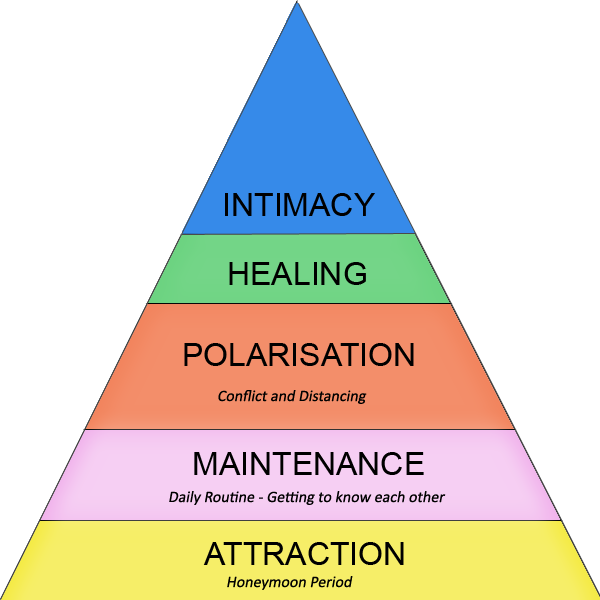
Relationships typically go through 5 stages, each one building on the stage before:

  1. Attraction - Little effort is required to feeling loving and loved
  2. Maintenance - Getting to know each other through day to day living
  3. Polarisation - Conflicts and arguments arise that create distance
  4. Healing - Conflicts are worked through
  5. Intimacy - Trust and good communication bring security and closeness

Attraction - Feeling Loving and Loved

Some couples come for relationship counselling early on in their
relationship  when they have been hurt before and just
need a bit support, a kind of health check to work through some
differences to allow trust to build.

In the Attraction Stage we usually see the best of each other. We are attracted to our partner’s qualities that compliment us or that we would like more of in ourselves. Attraction as well as being physical, is based on common values, similar status, shared ambitions and interests. It also has an unconscious element. Our unconscious attracts us to someone who is “familiar”  in some way. We are attracted to someone who fits our unconscious relationship bonding pattern.

Maintenance - Day to Day Living

We get to know each other through the routines of life. Some of the feelings of desire and passion fade. It's normal to some  face disappointment when our partner doesn't live up to the image we had of them. A loving emotional bond builds in getting to know the real person and being known ourselves. In this stage we might not feel safe enough to be fully ourselves and say what we feel, so we find ways of avoiding major conflict and feeling vulnerable.

We may avoid the big issues out of the fear of losing the love we want. We are comfortably close, yet avoid becoming closer, even though part of us  would like to be. It's common for there to be a distance/persuer pattern where one distances and the other pursues to maintain a safe distance of intimacy. For some of us our relationship may look fine on the outside, yet on the inside we don't feel relaxed and free to be ourselves. Often suppressing what we feel and avoiding talking about what we feel leads to a lack of energy and sexual desire for each other. Maybe there is, that ,'something missing feeling?' or  "I don't feel I am being myself ?" feeling. It could be we try hard to be the good partner, pushing down our needs and secretly feeling resentful that our partner doesn't reciprocate.  Maybe we would like more passion and grit, but we are not sure how to bring it into the relationship. So often the answer seems to be that," it's our partner that needs to change"; or the answer seems to be outside the relationship. We forget to make time to go on date nights and appreciate each other.

Relationship counselling  helps couples  communicate better and feel safe about exploring  what is important to them. Authenticity and trust brings  life energy into the relationship.

Polarisation - Conflicts and Arguments Create Distance

A degree of conflict is part of a healthy relationship. It's inevitable and good for the relationship. It's how we communicate and work through our differences that counts.  It is called the Polarisation stage because differences become a repelling force, making us feel so opposite from our partner. Arguments become unmanageable; issues can't be talked over, and resentment builds. We may be caught up in hurt feelings and begin to distrust our partner. There might be a sense of failure and a longing for things to go back as they were at the beginning of the relationship. Polarisation is triggered by events such as:-

  • Making a commitment
  • Moving in together
  • Soon after getting married
  • Around having children
  • A break of trust

Typically polarisation starts a few years into a marriage or committed relationship where it feels safe to move beyond the maintenance stage. Sometimes a partner attempts to deal with a feeling of disconnection through using pornography, drinking, or having an affair or doing something else that leads to a break of trust.

Our parents/caregivers gave us a model template on how to be in relationship. It's where we learned how to be loved and how to defend ourselves from being hurt. Our unconscious bonding patterns remain active in the ways we seek out love and in the ways we protect ourselves from being hurt. Often we protect ourselves by unconsciously trying to control our partner by becoming parental. In response they defend the activated vulnerable child feelings  by starting an arguement!  It might come as a surprise to discover that you and your partner unconsciously co-create the issues. It takes two. Yes, It’s bizarre, yet it's just how our unconscious works! Have you noticed how you can be more upset with your partner than anyone else? Some couples are fortunate in that they can work through or "live with" their bonding patterns in relative harmony without needing to look at them.For for many of us, our bonding patterns bring up strong emotions and feelings that we could really benefit from support to help us regulate powerful feelings and keep our relationship on track. Bonding patterns are not something to try to get rid of, instead the aim is to become more aware of them and find better ways of responding. Looking at them makes us more whole in ourselves and teaches us how to give and receive love.

Relationship counselling offers a safe space to understand how you trigger your partner, and how they trigger you. In the sessions you learn how to manage your bonding patterns, so that you can step back, see what is going on, and respond rather than react. You connect with the love and appreciation you feel for each other. You discover that issues can be spoken about and worked through without repeated arguments.

Healing - Conflicts are Worked Through

Healing is a process that happens over time as we learn to include both our strength and vulnerability. We appreciate the limits of what our partner can give us , and how to love and nourish ourselves at the times our partner can’t. We take responsibility for the relationship patterns that are no longer serving us. We learn to risk trusting again. Relationship counselling gives you the opportunity/ skills/ framework to stop blaming each other and work together on the shared bonding pattern. You can, end "the relationship (pattern) as it is” and learn together step-by-step, how to love again from a place of emotional freedom, authentic intimacy, power and choice.

I wish I could explain in just a few words the power of relationship  as a creative force to transform you Maybe for now let's say that  you are your partner might be together for a larger purpose than you might have initially thought.

Intimacy - Trust and Good Communication Bring Security and  More

We all want to love and be loved. In order for 'a meeting of hearts' to take place, barriers must be dropped. Intimacy is a challenge f as it requires us to step into the unknown, risk rejection and open our hearts. So often, in moments of intimacy we connect to our past longing and dependency. Relationship counselling helps you learn how to emotionally connect to each other so you feel secure that your partner is there for you. It's safe and step by step.

Conclusion

Relationships are a great challenge for most people. Some never dare to discuss with their partner how they really feel inside ( they stay in the Maintenance Stage); Others put up with and conflict and hostility (they stay in Polarisation Stage) or believe the solution is to leave their relationship and start over ( the denial of one's own pattern stage.)

Paradoxically, it's just at the point when everything feels stuck and hopeless, and in crisis, that there is the motivation to face up to what is not working. A Relationship counselling session once every other week is  powerful transformational process if you are stuck in conflicts and arguments that leave you emotionally disconnected from your partner. My experience is that most couples find getting help a relief, and those who are willing to take an honest look at what is going on ,worthwhile.

Copyright. 2011 Richard Cole

Men..When You Mess-Up - Admitting It Is An Option

Submitted by Richard on Fri, 07/29/2011 - 01:45

man woman bubbleMen, it’s inevitable that at times you are going to mess up and get things wrong for your partner. Here are some pointers that I hope you find helpful from my couples counselling experience. There's a lot of good material here.

<First Forgive Yourself Otherwise You Will Be Defensive

When you have messed up and your partner is upset the first step is to forgive yourself. Avoid if you can, going into shame and self-hatred. This is what lies beneath the surface for most men who react with anger and defensiveness. Accept that you are as fallible as the next man. You are not alone in messing up.There's a dignity to be found in accepting yourself regardless of what you have done and be accountable for clearing your mistake as best you can.

You can be present to your partner, comfort her, regret what you have done and make amends. You can do this while connected to your male power . You need to face up to your partner's hurt and anger. It will be uncomfortable. You will feel better by doing what is needed to be done.

Stay Connected to Yourself.

Your partner wants to connect to you on a feeling level. In order to be open to this you need to stay connected to your body, so feel your feet on the ground , breathe from the centre of you body. Feel your body supported by the ground. If you lose connection to yourself , slow things down, slow her down,tell her you need a minute if necessary.

Notice any uncomfortable feelings that come up as she is talking to you. See if you can soothe yourself, notice the feelings without reacting from them. If you notice yourself loosing connection with your body do something to reconnect.

<Avoid Attempting To Shut Down Your Partner's Feelings

Men who are uncomfortable with their feelings often worry about their partner's getting too upset, not realising that it is their own feelings they are attempting to protect. It is better to become aware of what you feel and not worry about your partner expressing her feelings. Your partner is well versed in being emotional, you don't need to worry about her being upset.

Listening Tips

There is no mental technique to make your partner's upset go away. What is required is just to do your best to be there and be sincere. If at anytime  you feel overwhelmed, or angry tell her you need a 'time-out' for 10 minutes. It's essential  you make it clear that you really want to hear her out.and that you will be back in 10 minutes. If you are feeling scared or uncomfortable, soothe yourself by remembering she's not your mother and she can't, 'make you or break you- only your self-judgment can.

Listen to her emotional flow. Women have a different communication style to men so don't expect her to speak like a man. Men tend get be literal and argue about details, whereas women tend to express what they are feeling in the moment without focusing on the details or literal meaning.

Sift for the gold. Translate inwardly to yourself any digs or criticism into what she is saying she is needing now. E.g. Translate ' You never listen', into 'I really want to be listened to right now'. It helps you both stay connected if you  keep some kind of physical contact. Be attentive. Every time you break contact it feels like abandonment to her. Listen to the hurt she wants to express.

The content isn't necessarily the message. Tune into what she is saying on a feeling level. Could it be that she feeling abandoned because you have been emotionally pulling away? Remember to keep your breathing flowing so you keep feeling, in response to what she is feeling. Holding your breath suppresses feeling and generates anxiety.

Don't let any arrows of 'you never do this..or do that !' stick in. - It might be her hurt speaking that is too tender to be directly expressed. If she is being unkind just let her know by saying, 'Ouch!' which might be all you need to say. There are limits, and sometimes you need to tell her what the limit is. You can remain in your power and not accept  attempts to punish you. Focus on what she is feeling and needing now. If it's not clear, ask her.

There's room for two realities - 'yours' and 'hers'. First focus on 'hers' . You can show you are hearing what she is saying by reflecting it back to her without disagreeing or adding your interpretation. It's a timing thing; First you need to listen and tune into what she is feeling. At this point there is no need to defend, no need to be right, no need to correct the details of her truth. Let her get her emotional flow out first. The time to disagree is later.

Show her you are listening and slow her down by stopping her flow every now and then and saying something like..'Let me see if I'm getting this...[repeat back the key themes]'
If she is overcome with emotion give her time to express it...make physical contact..slow things down.

She just wants you to hear her hurt. She wants you to feel with her rather than rationalise. If you have messed up she wants to admit that you, 'messed up',without justification, without defending, without collapsing.

A classic male response is to quickly jump in with "I'm sorry" followed by a long explanation about how bad the man feels. Women want men to hear their feelings not tell her about how bad they feel. Keep the focus on her. She needs you to be  sincere and to be saying in your own words,'I regret  that I've hurt you'. 'I've hurt you..I messed up'. 'I've let you down.'

Validate her Feelings If you listen to what she is saying and step into her reality and imagine how you would be feeling if you believed what she believes then it's easier to connect. What men tend to do is to disagree straight off and argue the details in a logical way. Your partner wants you to get how she 'feels'. The way not to do this is to say ,"I understand", quickly followed by your point of view. Instead of saying ,"I understand", tell her in detail what you understand.

E.g. In response to your partner worried about a text message from a female work colleague, here is how you could respond to your partner's feelings:

"You saw that message on my phone from Sue at work inviting me to a drinks do, and you are worrying if it's just a drinks do or something more , I can really see that not knowing any more, you begin to wonder if there is something going on between us..and you are worried, and feeling angry. You feel distanced from me and right now wondering if I'm telling you the truth. I would probably be feeling the same if I didn't know more about my work colleagues".

If you sincerely focus on the feelings  and can see that her feelings make sense ( given how she sees the situation) and you can communicate that. In effect you are showing that her feelings are important to you.

If your partner keeps bringing up the same hurt, it could be because you are not being heart-felt in acknowledging the'feeling message' in what she is saying or that you have not made an adjustment in your behaviour towards her.

Summary

  1. First, forgive yourself for messing up.
  2. Listen to your partner's emotional flow while staying in your male power
  3. Check out with her that you have got the' feeling message'.
  4. Take responsibility for what she is right about first. 'you are right, I've messed up, I let you down'. Express regret. Don't argue the details. Focus on the clear up.
  5. Set limits if necessary. Don't accept punishment.
  6. Discuss disagreements if you need to.
  7. Reassure her.
  8. Walk your Talk: Make adjustments to your behaviour to remedy the situation.

Relationship Counselling

Most men find staying present when they have 'messed up' somewhere between: hard to impossible. It's not easy! You and your partner trigger bonding patterns in each other that  pushes each other's buttons like no-one else can.

If you are stuck in repetitive arguments attend relationship counselling with your partner. It can help you both find ways to understand each other better and work through repetitive patterns. You will find that problems are co-created and you can both work together to improve your communication.

Couples Counselling - Emotionally Focused Therapy EFT

Submitted by Richard on Thu, 07/28/2011 - 22:59

when we were first together you made me feel so special

In this article:

  • See how a typical couple in couples counselling discover how to speak differently to each other by seeing the script at the start and the script from a later session.
  • Recognise the common themes that occur in arguments and see how emotionally focused therapy helps couples to speak more authentically to each other and work through difficulties.

Made up yet typical Extract at the beginning of relationship counselling:

Man: "You say I just want sex, but that is not true. I just feel like giving up when you say that , like we are doomed. How can it ever work?"

Woman: " I don't really know. But if you would just calm down and be less demanding. I just move away to stop the fights. I think it is better if we don't get caught in these arguments....it is easier that way"

Man: "How can things be 'easy' when we never make love, when you are never close to me ? Tell me that. It's like everything else comes first with you, but my feelings..they never count. You just focus on the event, like all I want is an orgasm. But that is not all I want. I want to feel close to you - desired- like I am important you. But first comes the kids, then the house, then your job, and then maybe if there is time left - maybe us."

Woman:"I just get that whatever I do I will never be good enough for you, I am a bid disappointment..so I just give up. I Just shut down. It doesn't feel safe anymore. I am not sexy enough for you, not warm enough - not enough"

Extract from a later relationship counselling to illustrate how the couple are able to speak more clearly about their feelings and needs.

Woman: " I am starting to feel safer here. Like I am not on trial all the time. I just give up when I feel that, I just shut down and go numb. I am starting to get that we both get scared and insecure and then we don't know how to reassure each other." I want this relationship and you are important to me - very important. I feel lonely too, you know. I just want to feel held sometimes, and talked to, paid attention to- not always asked to make love. Then I just feel I am a route to orgasm, not that you want me." ( she cries) "when we were first together you made me feel like I was so special - so precious. I miss that-I do. But know you seem so mad at me all the time"

Man:"I know. I get desperate - I feel like I am losing you - so I guess I come on all furious and pushy. But really it's just because I am so unsure of us-of you. And it's pretty risky to tell you this - I guess it's easier to demand to make love."

I'm sure some of this extract will resonate with couples. It shows how couples misunderstand each other and blame each other. The man and the woman both have their own realities on what is going on, both are which are valid. They both long to have a feeling of love and secure emotional connection.

The first extract shows the themes of abandonment, rejection and the lack of safety that comes from feeling that your partner doesn't prioritise you. The 2nd extract shows the risks involved in reaching out. The fear of asking for what you need. The fear of expressing vulnerability and building an emotional bond by sharing how important your partner is to you.

Emotionally focused therapy in couples counselling helps the man and the woman identify the patterns of blame and where the misunderstandings are. They begin to appreciate their own and their partner's vulnerability and be able to speak a deeper truth of what they are feeling and needing. Emotionally Focused Therapy in couples counselling shows couples that love comes from feeling that your partner is emotionally available to you, that want is important can be shared and received and that you are special and important to them. It teaches you how to communicate what's important.

Cheating - Why do Men and Women Cheat?

Submitted by Richard on Thu, 07/28/2011 - 14:36

cheating The reason men cheat isn't because they want sex. Men cheat because they miss the feeling of being admired and feeling a woman positively responding to them. Usually with their partner they feel criticised and undermined. Men need to feel they can make their partner happy and to feel admired and trusted. Men are motivated by knowing 'they can get things right' for their partner.

A lot of arguments are not really about the surface things, rather they are about a woman feeling the loss of an emotional connection and bond with their man. Not enough connection feels like abandonment. In an attempt to regain a connection women complain, and tell their men what they "are not doing right". Unfortunately men don't know that the complaining and criticism is actually a desire for connection. Men begin to believe that they, 'can't get it right for her' and lose self-esteem. Once the pattern starts of a man distancing and a woman complaining the man can become discouraged. When he tries to 'do the right thing', he soon gives up when the appreciation he longs for doesn't come instantly. He needs to perservere and appreciate his partner more in order to break the cycle.If he continues to distance it makes the lack of connection worse and his partner feeling more abandoned.

At these times some men are vulnerable to cheating on their partners to get a sense of self esteem and affection they long for. They attempt to re-experience what it is like to have a woman's positive attention. It's not really about sex at all. It's about the need to be admired.

Women cheat much less than men. They cheat as a last resort when they feel taken for granted by their partner. Women wish to feel appreciated, desired and special to their partner. Some women are more vulnerable to cheating if they have a friend who cheats as makes it seem more acceptable. The key factor for a woman deciding to cheat is that their partner has ignored their attempts to emotionally re-connect. Women cheat because their partner doesn't listen to them.

On the unconscious level an affair is an attempt at problem solving. It's curious how cheating partner's unconsciously let their partners' know they are cheating as if they want the main issue to come out into the open.

Cheating interrupts the emotional bond between a couple. The break in trust hurts, shocks and shakes the betrayed partner. A break of trust can be worked through in relationship counselling resulting in a stronger partnership. It's a tough process and it takes time to work through the root issues to a develop a more realistic informed trust. Informed trust replaces blind trust

What can you do now to strengthen your relationship and reduce the possibility of cheating?

There are steps you can take:

Schedule in time in your calendars each week to have special time together/go on a date/do something that nourishes your relationship.

Take an interest in the emotional life of your partner, ask them what they would like more of/less of in the relationship. Take an interest in what is important them.

Learn how to express your feelings and needs in a way that your partner can give to you rather than feel they need to defend against being attacked.

.Get in touch with your needs by taking time to notice the felt sensations in your body. By tuning into ourselves we can discover what we need. We all have needs, yet society conditions us not to listen to our needs. Women are conditioned to think of others, not themselves, Men are conditioned to be in control and be strong. If we are not in touch of our needs and are unable to express them, we tend to unconsciously act them out

  1. Notice any tightness in your stomach and chest. Just keep your attention on the area and wait expectantly to see what feelings arise.
  2. Put what you are feeling/needing into words.
  3. Shape those words into a doable request. E.g. You notice some tightness under your rib cage..it's fear that your partner is meeting some friends tonight and you are wanting to feel emotionally closer to them. You realise you are some needing reassurance and closeness. You risk saying how you are feeling and make a request to your partner..I want to feel closer to you, I value spending time with you yet I feeling scared that you don't want to spend time with me. I'd really like it if we could do something together on Thursday ? and I could really do with a hug right now.

The surprising thing is that when we risk coming from our heart with what we want without attacking our partner, they feel connected to us and usually respond lovingly.

It's basic and powerful. Women, men want to be admired ( they want to know they can "get it right for you" and be appreciated for it). So if you are woman, ask your partner to help you with something that will make him feel good as a man and appreciate him
for it.

Men,women want to feel special. So tune in to what makes your partner feel special: Does she respond to loving words,
appreciations,gifts, you doing something for her, spending time together, surprise night out, physical touch? Women need to be told over and over that they are special. It's hard for men to understand how important it is for women.

Do You Have Trouble Expressing How You Feel?

Why not take steps to address it and get support. It's so much easier to work things through before drifting apart or resorting to "cheating" to bring what isn't being spoken about into the open

Copyright Richard Cole (2011)

Signed into Google ? See a Google + 1 button? Click it to give this webpage a positive vote - thank-you!